
How to Search the Denver County Court Docket
Start with jurisdiction. Denver County Court offers a free Quick Case Search. It works when you already hold a County Court case number or an Arrest Booking number. A valid number unlocks the Register of Actions. That is often shortened to ROA. You also get the case schedule, parties, charges, sentences, fines and costs, payments, bonds, and officer details. The search does not display public images. Pleadings and orders listed in the ROA stay text-only entries. For Denver District, Probate, or Juvenile settings, turn instead to the Colorado Judicial Branch Docket Search. That state service lists scheduled proceedings rather than a free statewide ROA. When a docket search fails in one system, check the other court before drawing any conclusion about the case.
- Read the court name and case number on the latest court paper.
- Use the Denver County Court portal for County Court numbers, including GV, GS, and D matters.
- Use the state docket search for Denver District, Probate, or Juvenile settings.
- Record the current date, time, hearing type, place, and appearance method.
- Contact the owning clerk for the document named in an entry or for a certified copy.
Note: A future-date name search is a date finder, not a complete history search.
Denver County Public Portal Fields
The court built its Public Portal with several search paths. The direct lookup first asks whether you have a case number or an AB number. Then it requests the matching identifier. Prefer the noncivil future-date form? That one needs a last name, first name, and date of birth. The civil version accepts a person's first and last name or a business name. Both name paths show only active future dates.
| Portal path | Input | Result |
|---|---|---|
| Direct case search | Case number or AB number | ROA and case-detail tabs |
| Find court date | Name and date of birth | Active future noncivil setting |
| Find civil court date | Name or business | Active future civil setting |
| Daily docket | Courtroom and date | Scheduled courtroom list |
The official Denver County Court home page gathers these services in one place. Its entry points split by task, so pick your job before you click. Treating every button as the same database leads to dead ends.
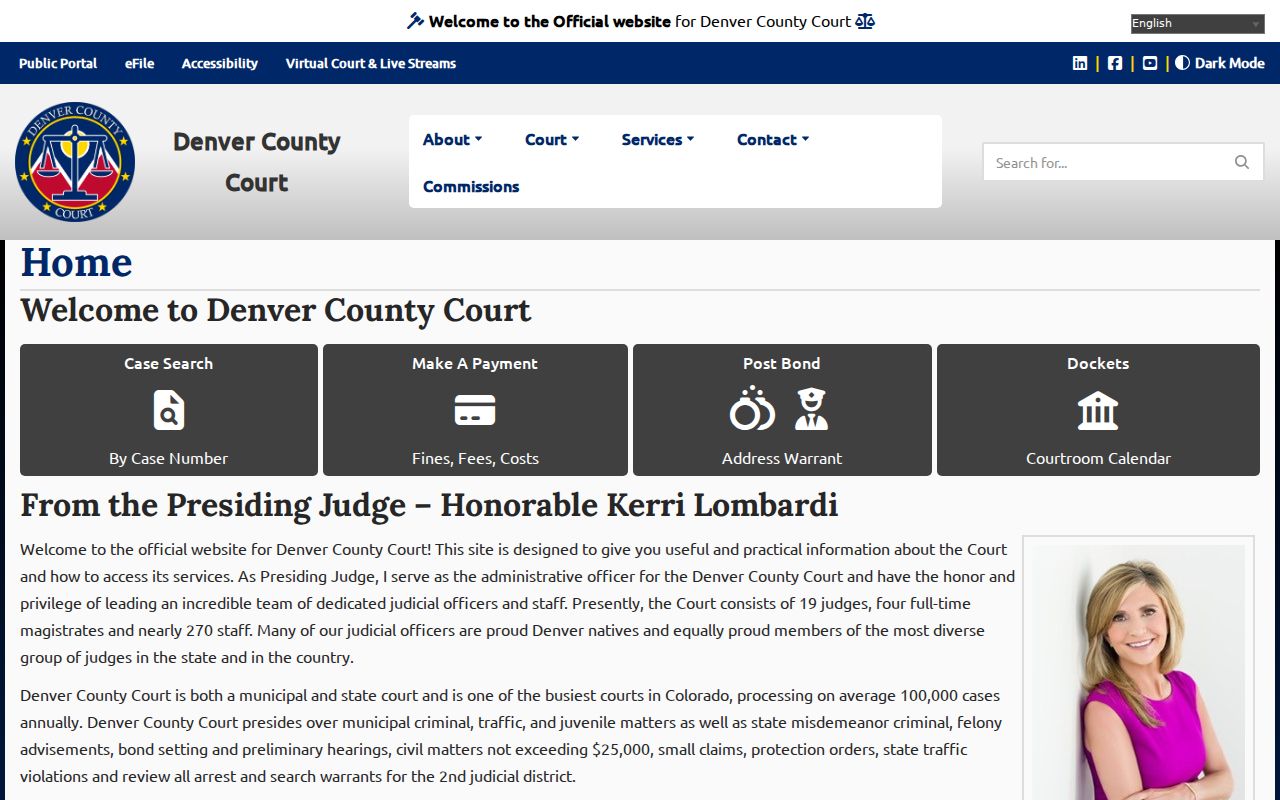
The portal lays out the court's own routes to dockets, cases, payments, bonds, e-filing, and virtual court access.
What a Denver County Court Docket Shows
A Denver County Court ROA is a dated index of case activity. It tells you what was filed or heard, and when. The filed document itself is a separate record. County Court also uses "docket" for a courtroom's scheduled list. Context matters. A daily docket answers who is set in a given room on a given date. An ROA follows one case through time instead.
| Case Number | The year, case-type code, and sequence, or a local County Court identifier. |
|---|---|
| Parties | The roles and names displayed under the access rules for the case. |
| Entries | Dated filings, notices, hearings, minute orders, rulings, and later action. |
| Settings | The date, time, hearing type, place, courtroom, and appearance mode. |
| Charges or Claims | Alleged offenses in criminal matters or the claim type in civil matters. |
| Disposition | The recorded outcome, which is distinct from an allegation or an old setting. |
Local case codes help steer a docket search in the right direction. State cases usually carry a four-digit year plus CR, CV, DR, PR, or JV. The state request form sends some numbers back. Denver GV, GS, and D numbers go to Denver County Court. A sample state pattern looks like 2024CR####.
Why Denver Has Two Docket Systems
Denver does court business in a way most Colorado counties do not. The city and county are consolidated. Denver County Court runs on its own administration instead of operating like a branch-run county court. The result is two separate technology systems and two clerk offices. Denver County Court has its own Public Portal. It offers local e-filing. Denver District Court works through Colorado Judicial Branch services and Colorado Courts E-Filing. Which side a case lands on depends on the charge or claim. The building you visit does not decide it. A felony might start in County Court for advisement, bond, or a preliminary hearing. The merits then move to District Court. Smaller civil suits can stay in County Court; bigger civil cases and domestic-relations matters belong in District Court. For the state-run side of the Denver County court docket, the Second Judicial District page is where to begin. It is the official entry point for Denver District Court records.
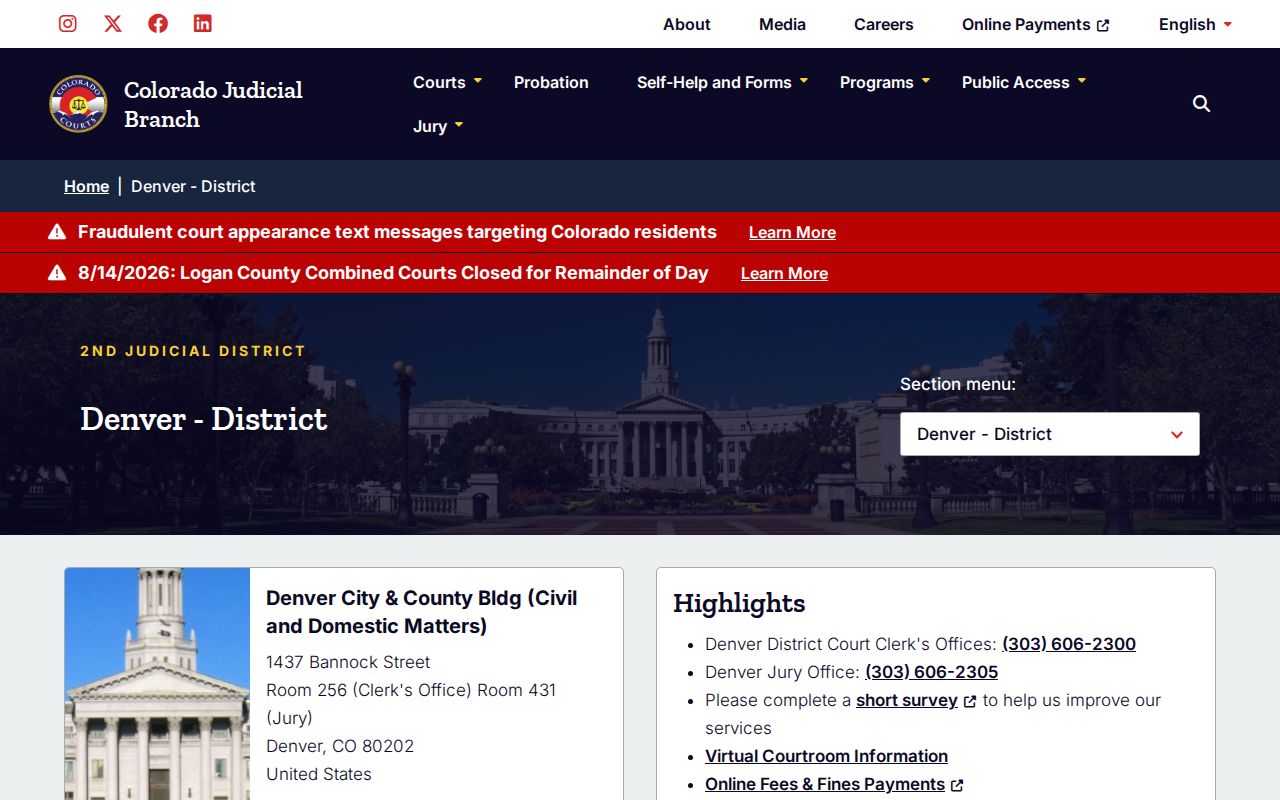
This separation is why one person or event can require checking more than one official source.
Which Denver County Courts Keep Dockets
"Denver court" names no single office. The city holds County, District, Probate, and Juvenile courts, plus state appellate and federal courts. Naming the venue first avoids a misrouted request and narrows the search fields.
| Court | Docket covers | Where to start |
|---|---|---|
| Denver County Court | Municipal and state misdemeanors, traffic, civil through $25,000, small claims, protection orders, felony first stages | County Court Public Portal or its clerk counters |
| Denver District Court | Felonies, major civil cases, and domestic relations | Colorado docket search and District records office |
| Denver Probate Court | Estates, guardianships, and conservatorships | Probate court and its records channel |
| Denver Juvenile Court | Dependency, delinquency, and statutory juvenile matters | Juvenile court, subject to access limits |
| Colorado Court of Appeals | Most appeals from District, Probate, and Juvenile courts | Official appellate court service |
Denver County runs its own probate bench: the Denver Probate Court stands apart under the state constitution and now sits in Colorado's 24th Judicial District.
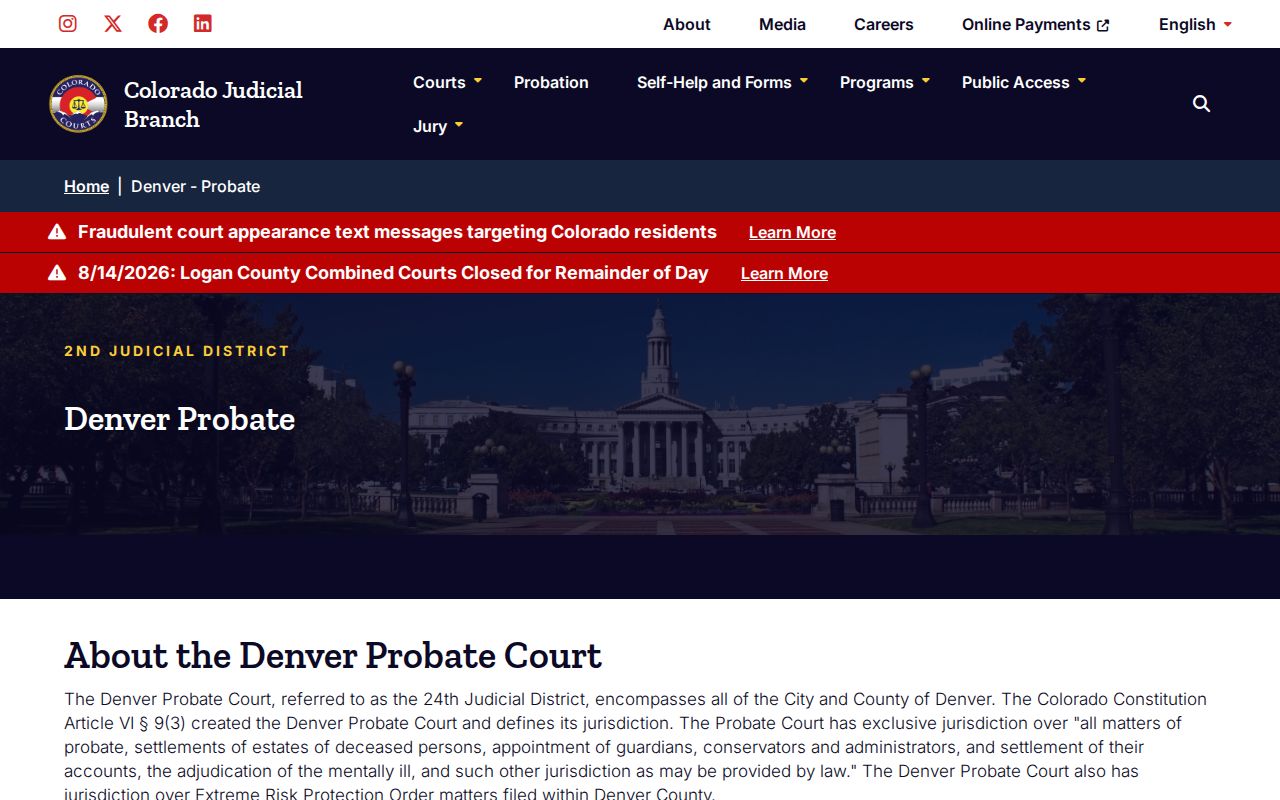
Probate material can be restricted even when a surrounding case exists. So a portal gap does not prove the court holds no file.
Denver County Docket Filing Scale
For a historical measure of local workload, see the Denver Auditor's 2018 court-operations report. It recorded 125,523 filings in 2017. The breakdown: 85,489 traffic, 18,760 General Session, and 21,274 misdemeanor-criminal filings. The same report counted about 117,000 dispositions. It also lists 19,702 bonds processed and 22,126 warrants issued. Treat these as 2017 operating figures, not current estimates.
Volume like that explains why the portal separates schedule, charges, sentence, finance, bond, and officer data. It also explains the two clerk counters. Use the statistic to set routing expectations, not as a current caseload claim.
Finding Denver County Court Dates
Know the County Court case already? Open its Case Schedule. Need a courtroom list? Use the daily Docket Search with both a room and a date. For District, Probate, or Juvenile matters, use the Colorado Judicial calendar with a date plus at least one other filter. State results may list time, expected duration, caption, case number, hearing type, location, appearance type, and courtroom.
An older setting stays part of the Denver County court docket even after a reset. The latest current setting controls. Note whether the event is marked IN PERSON, TELEPHONE, or another mode, then recheck close to the date. The full Denver County court calendar process covers each official route.
- Setting
- A scheduled court event with a time and hearing type.
- Reset
- A move from an old date to a new one.
- Disposition
- The way a charge or case ended, not merely a setting status.
- Minute order
- A short official record of action taken in court.
Denver County Room Assignments Can Move
A Denver County Court schedule may list clerk rooms 135 and 160. It can change them the next day. The court itself warns that either room can be reassigned within 48 hours. Neither is a fixed courtroom. Both are clerk offices. A docket entry you saved days ago might be an accurate old listing. That listing may no longer tell you where to appear.
So check the schedule again close to your court date. Read the newest event. If the room or the appearance method is unclear, call the clerk. Use the clerk assigned to that case type. Criminal and municipal questions belong with the Lindsey-Flanigan clerk. Traffic and civil questions go to the City and County Building clerk. A public video stream exists only when the judicial officer turns it on. Recording or reproducing that stream is prohibited.
For the full list of offices, use the Denver County Court contact directory. It lays out both buildings and which clerk handles which docket.
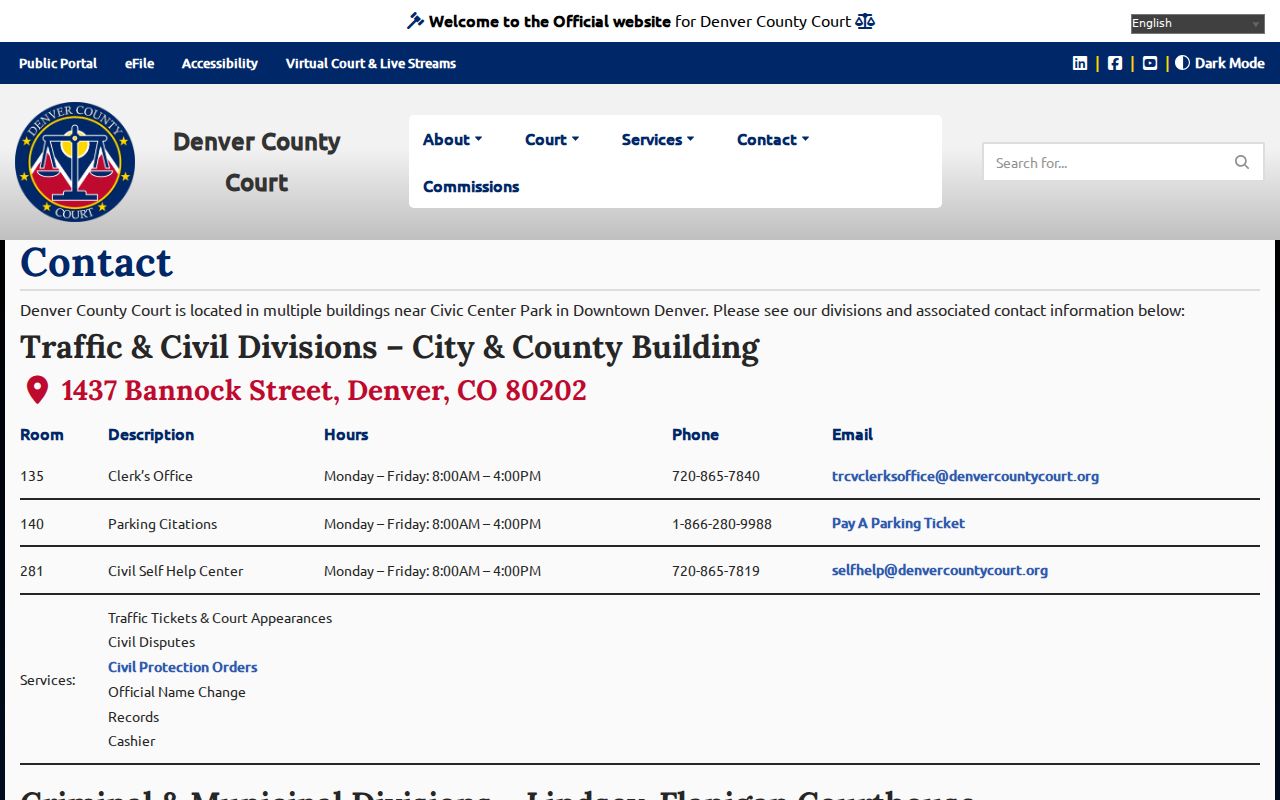
Denver County Court contact directory: when a last-minute docket entry leaves the room or division in doubt, this page is the fastest way to reach the right clerk.
Public Access to Denver County Court Dockets
Colorado opens its courts through a blend of judicial directives and statutes. What you usually get first is an event index. It is not free downloads of every filed paper. Some material stays off limits. Sealed cases, juvenile files, protected probate and family matters, and personal identifiers are excluded. Someone with a legal right to protected material may still need government-issued photo identification. A court order may be required to see it.
Key rules:
CJD 05-01 sets Judicial Department access, remote-access, exclusion, request, and fee policy.
Colorado Open Records Act, C.R.S. §§24-72-201 et seq. governs public records, while court files also follow court directives.
Colorado Criminal Justice Records Act, C.R.S. §§24-72-301 et seq. distinguishes records of official action from other criminal justice records.
C.R.S. §13-1-132 and CJD 23-02 allow certain open-proceeding streams but bar unauthorized recording.
Portal data makes a handy public reference. The clerk's file is what counts, though, and only a certified copy carries the clerk's authentication. A screen print never will.
Limits of Denver County Docket Access
The free County Court portal has real limits for a Denver County docket search. Its name fields only work for cases with active future dates. So there is no general historical search for a person or business. It also shows no public document images. The state Judicial Branch calendar is not a free statewide ROA. Contracted search products cannot issue official copies.
When a Denver County court docket will not appear, check the number, the spelling, the court, and that future-date limit first. Then ask the right clerk. Ask whether the case is old, off site, sealed, suppressed, or filed in Denver's other court system. A blank result by itself proves nothing about sealing. Juvenile, adoption, and protected family or probate records follow rules of their own. Those rules sit beyond ordinary adult docket access.
The Denver Juvenile Court page names the separate juvenile venue and what it covers.
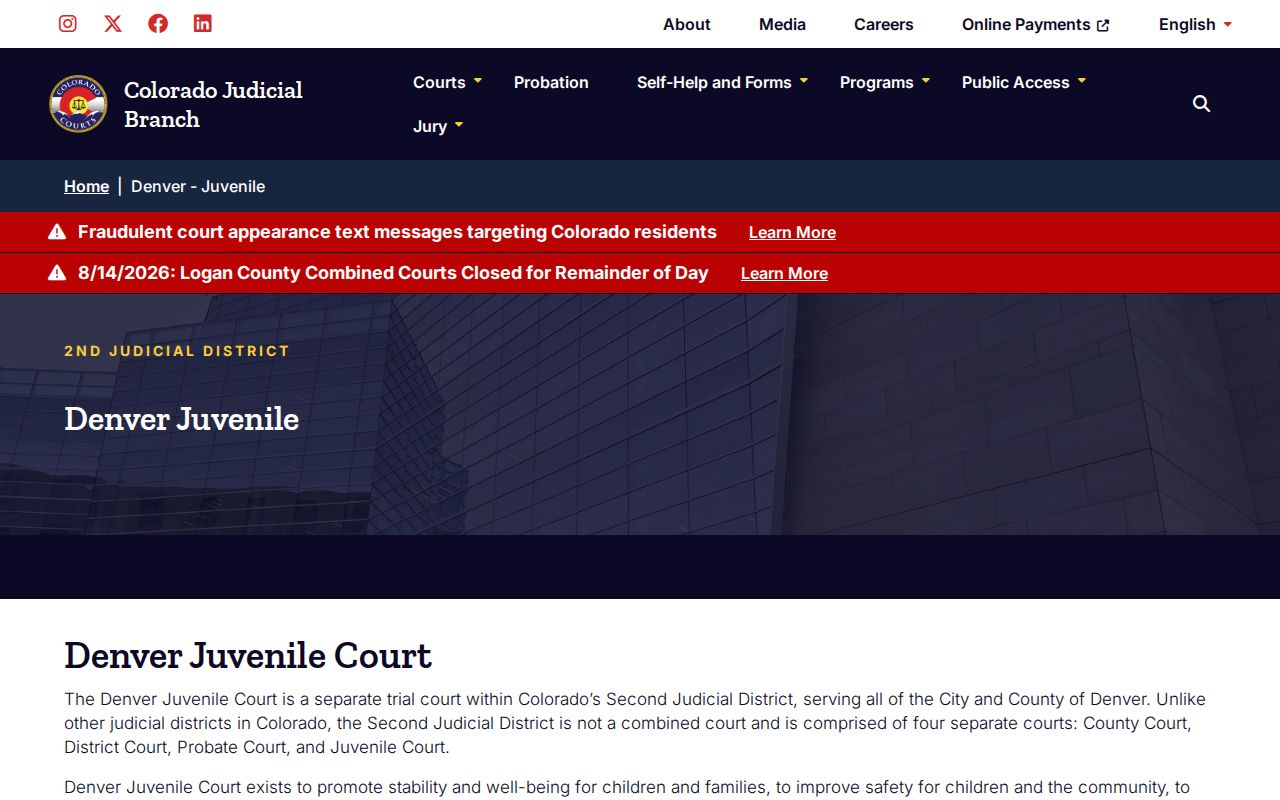
That separate juvenile court is one reason a County Court portal search can never cover every Denver matter. Some dockets simply live elsewhere.
The Denver County Clerk and Docket Records
No single clerk holds every Denver County court docket. County Court criminal and municipal copies come from Room 160 at Lindsey-Flanigan, or 160records@denvercountycourt.org. Traffic and civil copies route to Room 135 at the City and County Building. That office also takes civil@denvercountycourt.org. State-run District records are different. The Clerk of Court for Denver District Court takes those requests at its counter, through its request form, by email, mail, or phone.
Bring the case number. Name the exact document title and date from the ROA. Paper-file requests to the state usually get an answer within three business days. Circumstances can demand more. Some protected requests require identification. The clerk can explain process and fees, but never legal advice.
Denver County Court Traffic and Civil Clerk
1437 Bannock Street, Room 135
Denver, CO 80202
720-865-7840
Denver County Court Criminal and Municipal Clerk
520 West Colfax Avenue, Room 160
Denver, CO 80204
720-337-0410
Denver County Written Record Requests
A formal Denver County Court data or records request can go three ways. Email coradatarequests@denvercountycourt.org. Hand delivery to either clerk office works too. Or mail it to 1437 Bannock Street, Attn: Record Request, Denver, CO 80202. Phone calls and social-media messages do not count. An email must put the request in the body; an attachment alone goes unprocessed.
Keep the ask narrow. Give the case number, the parties, the type or year, and the exact entry or document. Then say whether you need an electronic, paper, certified, or exemplified copy. Denver County Court often sends ordinary electronic copies with no copy charge. Paper runs $0.25 per page. Certification adds $20 per document. Broad research or redaction work costs $41 per hour after the first hour. The court sends an estimate and wants payment before release.
Stay responsive, too. A request can be deemed abandoned after ten days without clarification, payment, or pickup. The court will not build a custom report or alter a record to fill a request. That makes a precise ROA citation worth the effort.
Denver County Courthouse Docket Routes
Two buildings split the Denver County courthouse docket work. The City and County Building at 1437 Bannock Street holds the County Court traffic and civil counter in Room 135 plus the District Court civil, domestic, and records counter in Room 256. Lindsey-Flanigan Courthouse at 520 West Colfax Avenue is the criminal and municipal hub, with the County Court clerk in Room 160. Expect building security, and follow the current device rules.
Subject matter decides your counter. County Court filings cannot be downloaded from the public portal, so walking in stays a dependable route. Mail and email work too. Denver District also accepts its state web form and a local paper request form. No public terminal with broader fields or images than the web tools is offered, so plan around what the portals provide.
Probate and Juvenile keep their own record paths. Federal cases sit outside both local portals entirely, in PACER and the U.S. District Court for the District of Colorado. Similar street addresses do not merge these offices.
Court Dockets by City in Denver County
Denver County and the City of Denver are the same place, one consolidated government. The U.S. Census Bureau Denver County profile tracks that single city-county entity. There are no separate incorporated cities here with their own municipal courts. One forum handles the work. Denver County Court serves as both the municipal docket and the county-level lower trial court. A single city docket page covers the whole jurisdiction.
Denver Court Docket
715,522 residents in the 2020 Census · one consolidated municipal and county court system
The Denver city docket covers local ordinance matters, misdemeanors, traffic cases, lower civil claims, small claims, protection orders, and early felony proceedings. Bigger cases go elsewhere. Denver District Court takes major civil, domestic, and felony merits matters.
Map and Directions to Denver's Courthouses
Denver District Court's civil, domestic-relations, and records counter is in Room 256 of the City and County Building, 1437 Bannock Street, which also holds Denver County Court's Traffic and Civil clerk in Room 135. Criminal and municipal matters, including County Court's felony advisements and bond settings that precede a District felony filing, are handled at the separate Lindsey-Flanigan Courthouse a few blocks away. Both buildings use entry security screening, so plan extra time before a hearing.
City and County Building (District Civil/Domestic, Room 256)
1437 Bannock Street
Denver, CO 80202
Monday through Friday, 8:00 a.m. to 4:00 p.m.
Lindsey-Flanigan Courthouse (Criminal/Municipal, Room 160)
520 West Colfax Avenue
Denver, CO 80204
720-337-0410
7:30 a.m. to 4:00 p.m.
Follow posted device and conduct restrictions at either building, and recheck a Room 135 or Room 160 courtroom assignment close to the hearing time, since clerk-room designations can be reassigned within 48 hours. No official source confirmed a public-terminal, parking, or locker policy, so call the relevant clerk before a long trip.