
How to Search Criminal Dockets
Let the court name and case number drive the first docket lookup. Have a Denver County Court case or arrest booking number? Try the free Quick Case Search. Know a courtroom and a date instead? The daily docket tool is built for that. A Denver District Court felony setting lives in the Colorado Judicial Branch Docket Search, filtered to Denver and the Second Judicial District. Missing a number entirely? A name plus a date of birth can surface an active future County Court date. That tool will not sweep past cases by name. Follow that path, then check the other court before concluding that no case exists.
- Read the court name and case identifier from the summons, bond paper, notice, or prior order.
- Search Denver County Court by case number or AB number, or search the state docket for a District Court setting.
- Open the matching case and confirm the court, party, charge, current status, and latest setting.
- Read later reset, plea, disposition, and sentence entries before drawing a conclusion from an older event.
- Ask the owning clerk for the actual filing or a certified disposition when the portal summary is not enough.
Denver Criminal Docket Portal
The County Court Public Portal splits the Register of Actions from other case facts. Its case view may list the schedule and parties. It may also show charges, sentences, fines and costs, payments, bonds posted, and officer information. The daily Denver criminal docket adds case number, AB or ticket number, and status. It also gives language, hearing type, time, disposition, domestic-violence marker, counsel, and date of birth. What displays depends on public-access rules and your role. The portal shows no public images of the complaint, motion, minute order, or sentence. It also allows no broad public person-name search. A valid number unlocks the useful history. The name-and-birth-date tool only finds cases with an active future date.
Denver Criminal Docket Handoff
Denver County Court handles state misdemeanors, municipal offenses, felony advisements, bond settings, and preliminary hearings. The felony merits then move to Denver District Court. One prosecution can therefore leave a trail across both court records. County Court holds the first appearance and bond. The District Court docket carries the filed felony, arraignment, motions, trial or plea, sentence, and later review.
| Stage | Likely court | Search route |
|---|---|---|
| Misdemeanor or municipal case | Denver County Court | Local Public Portal |
| Felony advisement or preliminary event | Denver County Court | Local ROA and schedule |
| Filed felony merits case | Denver District Court | State docket and District clerk |
No District result? The case may simply not have reached that stage yet. And a County Court entry alone never proves the felony stayed there.
What a Criminal Docket Shows
A Denver criminal Register of Actions is a dated index. It is not a packet of downloadable filings. Read the header first. Then follow the events in order. District cases typically run a four-digit year, class, and sequence, such as 2026CR1234. County Court often uses local GV, GS, or D forms, plus booking or ticket identifiers.
| Case Number | Identifies the court system, filing year, class, and sequence where coded. |
|---|---|
| Charge | Lists the alleged offense and may include the statute or class; it is not a conviction. |
| Hearing Settings | Shows advisement, arraignment, pretrial, motion, trial, sentencing, or review events. |
| Bond and Plea | Tracks release action and the accused person's formal response where public. |
| Disposition | Records dismissal, plea or verdict result, and sentence-related entries. |
Read the Denver criminal docket as a whole. No single field gives enough context to state the current stage or final result.
Denver Criminal Docket Outcomes
A charge is an allegation. It does not establish guilt. Bond posted records a release transaction, nothing about how the case ended. A past trial setting proves no trial happened either. The controlling entry is whatever came later: continuance, plea, dismissal, or sentence, and that sets the current reading of the Denver criminal docket.
- Disposition
- The recorded way a charge or case ended.
- Minute order
- A concise official account of action taken in court.
- Reset
- A setting moved to a new date, with the old event often left in history.
- Sentence
- The court-ordered result after a conviction or plea.
Need official proof? Ask the clerk for the filed disposition or a certified copy. A printout of the public screen is not certified.
Stages on a Criminal Docket
The Denver criminal docket may open with a complaint or information. Advisement, counsel, bond, and a preliminary hearing follow where they apply. A felony handoff brings a District filing. Arraignment and the motions come later. Misdemeanor and municipal cases can stay in County Court the whole way. Read each hearing with its court, date, and current status.
Docket flow: Filing › Advisement › Arraignment › Pretrial › Plea or Trial › Disposition › Sentencing
More can follow: post-sentence reviews, financial entries, a notice of appeal, or a sealing event. Those later records do not erase the earlier path. A sealed case, though, may vanish from ordinary public access.
Denver Criminal Specialty Dockets
Denver runs named problem-solving calendars, but the underlying criminal number remains the key search tool. The official Denver specialty-court path lists Sobriety Court for eligible repeat DUI matters. It also lists Outreach Court for selected municipal citations and warrants. Recovery Court opened March 23, 2026 for eligible drug or drug-adjacent cases. District programs include RESTART, Veterans Treatment Court, DIVERT Adult Drug Court, and the REACH competency docket. Public entries may show review settings, orders, and disposition. Clinical assessments, treatment reports, and other protected material stay private. That holds even when a review date appears. Admission rests on eligibility, court action, and the actual record. Any later reduction, dismissal, or sealing rests there too.
Denver Criminal Docket Volume
The official Second Judicial District overview counted about 5,539 felony criminal cases in 2024. It also notes that Denver criminal filings include bind-over cases received from County Court, which confirms the two-system handoff. Those state figures do not capture the separately run County Court's full volume.
The split is why a careful Denver criminal docket search records both the court name and the case number. A name alone cannot reliably route the matter.
Which Court Holds Criminal Dockets
Denver splits its criminal dockets by severity and by court. Felonies live in Denver District Court. The Clerk of Court there keeps those records. Denver County Court handles state misdemeanors and municipal cases. It also hosts felony advisements, bond settings, and preliminary hearings. Denver Juvenile Court stands apart under the state constitution. It holds juvenile records behind stricter access rules.
Need a County Court copy? Head to the clerk in Room 160 at the Lindsey-Flanigan Courthouse, 520 West Colfax Avenue. You can also email 160records@denvercountycourt.org. That office answers the phone at 720-337-0410. District Court records run through Room 256 at 1437 Bannock Street. Other routes include email to denverdcrecordsrequest@judicial.state.co.us, the state request form, mail, or a call to 303-606-2300 with options 1, 5, 1. The Judicial Branch adds Denver District Court resources covering local orders and forms.
Federal charges are a different world. Prosecutions there belong to the District of Colorado, not either Denver criminal portal. The U.S. Attorney's Office and the U.S. Marshals district page mark that separate federal layer.
Denver Criminal Docket Appeals
The Colorado Court of Appeals page lays out the state appellate layer that follows many District Court matters.
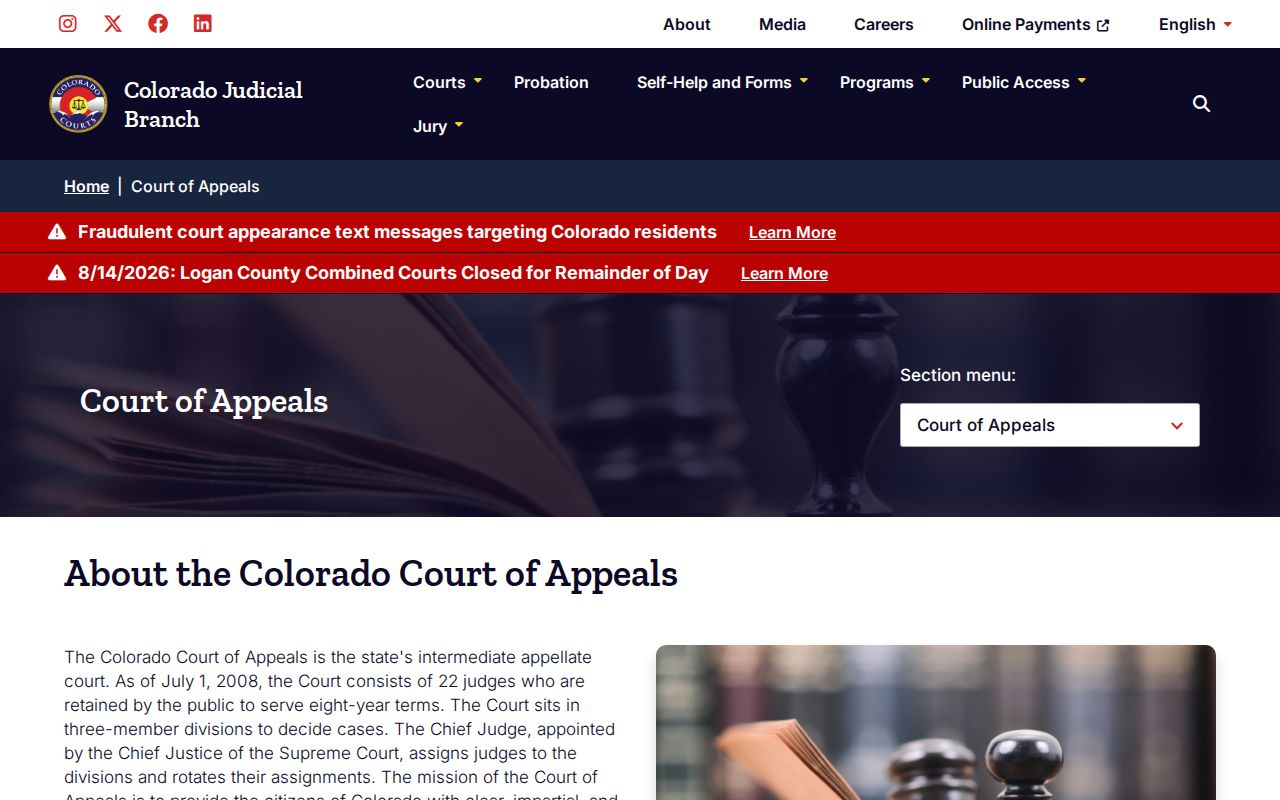
That page reflects a separate appellate record, not a substitute for the Denver trial-court ROA. A Denver County Court appeal goes first to Denver District Court. The rule for that case type governs the route. The Colorado Supreme Court sits at the top as the state's final appellate court. County Court criminal, municipal, traffic, and parking appeals generally demand a notice and transcript designation. It is filed with both courts within 35 days after sentencing or after denial of a post-trial motion. Miss that window and the appeal can fail on timing alone. The Denver County Court appeal clerk takes questions at dccappeal@denvercountycourt.org.
Missing Denver Criminal Dockets
An empty search result is not proof the record is gone. Start by rechecking the case number and switching between the County Court and District Court systems. Some tools display only active future dates. Older cases may sit off-site, and sealed, suppressed, juvenile, or otherwise protected files stay hidden from public view.
For a County Court filing on paper, email Room 160 or stop at the counter. Formal data requests go to coradatarequests@denvercountycourt.org or by mail to 1437 Bannock Street, Attn: Record Request, Denver, CO 80202. Put the specifications in the email body itself; attachment-only requests are not processed. A phone call can sort out routing, but County Court will not treat a call as a formal records request.
Public Access and Sealed Criminal Dockets
Open Denver criminal dockets serve civic reference well. Still, remote access is narrower than what the clerk sees. County Court gives a free ROA by case number. There are no document images and no broad name search. State courts post settings at no charge, while filed papers come from the proper clerk. Sealed cases simply drop out of the public portal. Juvenile files, protected identifiers, and certain suppressed records require a legal basis. They may also call for government-issued photo identification.
Key Rules:
CJD 05-01 governs Colorado Judicial Department court-record access, exclusions, remote display, and requests.
Colorado Criminal Justice Records Act, C.R.S. §§24-72-301 et seq. distinguishes records of official action from other criminal justice records.
Children's Code, C.R.S. §§19-1-301 et seq. chiefly controls access to juvenile court records.
When remote access hits a wall, the right Denver clerk can walk you through the request process but cannot hand over anything barred by law or court order. The Judicial Branch record-sealing self-help route explains the steps for a person with an eligible case. A portal status by itself proves nothing about eligibility.
Denver Criminal Docket Copies
Start with the ROA. Pin down the exact complaint, minute order, disposition, or sentence by date. Then list the case number, court, parties, and document title in your request. County Court supplies ordinary electronic copies in many cases. Paper copies run $0.25 per page, and certification adds $20 per document. District Court charges follow the state schedule.
A certified disposition is not the portal's event list. It carries clerk authentication, which matters for formal use. Broad requests may need retrieval and redaction, so a narrow document-and-date request works better. Denver County Court gives an estimate and wants payment before release. For the wider gap between an index and the documents behind it, see the Denver County court records process.